Access Requery Subform After Update Cannot Connect
I've a main form "Properties", which has two subforms, one of which displays the rooms in that property, the other one occupants in each room. As you change the. Calculated control. A control that is used on a form, report, or data access page to display the result of an expression. The result is recalculated each time there. Making Sense of List Boxes. When I first started building Access forms I couldn't understand what was the point of a list box. To me it was just like a combo. Tips and techniques from FMS for building better applications in Microsoft Access, Visual Basic 6, VB6, VBA, Outlook, SQL Server, Visual Studio.NET, Internet, Office. Note: Microsoft Office Access displays event names slightly differently in the Visual Basic Editor than it does in the property sheet and the Macro Builder.
Order of events for database objects. A single action, such as moving from one control on an object to another control, can trigger several different events, which occur in a particular sequence. Knowing when events occur and in what order they occur is important, because it can affect how and when your macros or event procedures run. For example, if there are two event procedures that are to be run in a certain order, you want to make sure that the events that they are associated with occur in that same order. Order of events for controls on forms. Events occur for controls on forms when you move the focus to a control, and when you change and update data in a control. Note: Microsoft Office Access displays event names slightly differently in the Visual Basic Editor than it does in the property sheet and the Macro Builder.
For example, the event named On Got Focus in the form's property sheet and in the Macro Builder is named Got. Focus in the Visual Basic Editor. The examples in this article use the Visual Basic for Applications (VBA) format for event names. Moving the focus to a control. When you move the focus to a control on a form (for example, by opening a form that contains one or more active controls, or by moving the focus to another control on the same form), the Enter and Got.
Focus events occur in this order: Enter. Got. Focus. When you open a form, the Enter and Got. Focus events occur after the events associated with opening the form (such as Open, Activate, and Current), as follows: Open (form). Activate (form). Current (form). Enter (control). Got.
Focus (control)When the focus leaves a control on a form (for example, when you close a form that contains one or more active controls, or when you move to another control on the same form), the Exit and Lost. Focus events occur in this order: Exit. Lost. Focus. When you close a form, the Exit and Lost.
Focus events occur before the events associated with closing the form (such as Unload, Deactivate, and Close), as follows: Exit (control). Lost. Focus (control). Unload (form). Deactivate (form).
Close (form)Changing and updating data in a control. When you enter or change data in a control on a form and then move the focus to another control, the Before. Update and After. Update events occur: Before. Update. After. Update. The Exit and Lost.
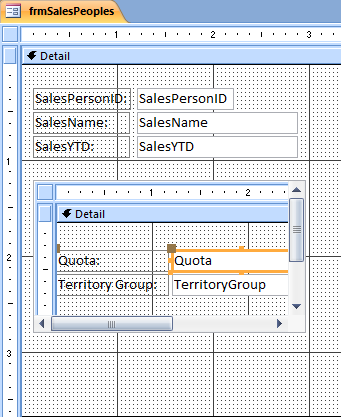
Thanks again. The requery cannot happen on the subform itself, it happens from actions on the main form. Actually, it happens based on a button press in a different. Over 100 tips for creating faster Microsoft Access databases by optimizing and improving their performance in your applications.
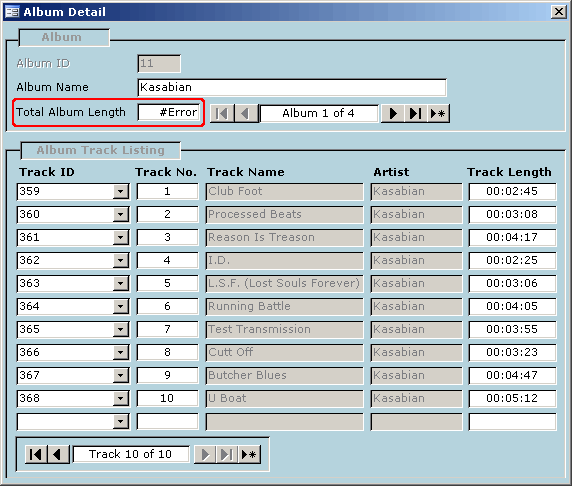
Focus events for a control whose value changes occur after the Before. Update and After. Update events: Before. Update. After. Update. Exit. Lost. Focus. When you change the text in a text box or in the text box section of a combo box, the Change event occurs. This event occurs whenever the contents of the control change, but before you move the focus to a different control or record (and therefore, before the Before.
Update and After. Update events occur). The following sequence of events occurs for each key that you press in a text box or in the text box section of a combo box: Key. Down. Key. Press. Dirty. Change. Key. Up. The Not. In. List event occurs after you enter a value in a combo box that is not found in the combo box list and then try to move the focus to another control or record.
The Not. In. List event occurs after the keyboard events and the Change events for the combo box, but before the events for any other control or the form. If the Limit. To. List property of the combo box is set to Yes, the Error event for the form occurs immediately after the Not.
In. List event: Key. Down. Key. Press. Dirty. Change. Key. Up. Not. In. List. Error. Top of Page.
Order of events for records on forms. Events occur for records on forms when you move the focus to a different record, update data in a record, delete an existing record or records, or create a new record. Moving the focus to records and updating data in records. When you move the focus to an existing record on a form, enter or change data in the record, and then move the focus to another record, the following sequence of events occurs for the form: Current (form).
Before. Update (form). After. Update (form). Current (form)When you leave the record whose data has changed, but before you enter the next record, the Exit and Lost. Focus events occur for the control that has the focus.
These events occur after the Before. Update and After. Update events for the form, as follows: Before. Update (form). After. Update (form). Exit (control). Lost. Focus (control). Record. Exit (form).
Current (form)As you move the focus among the controls on a form, events occur for each control. For example, the following sequences of events occur when you do the following: Deleting records. When you delete a record, the following events occur for the form, and Microsoft Office Access displays a dialog box asking you to confirm the deletion: Delete.
Before. Del. Confirm. After. Del. Confirm. If you cancel the Delete event, the Before.
Del. Confirm and After. Del. Confirm events do not occur, and the dialog box is not displayed. Creating a new record.
When you move the focus to a new (blank) record on a form and then create a new record by typing data in a control, the following sequence of events occurs: Current (form). Enter (control). Got. Focus (control). Before. Insert (form). After.
Insert (form)The Before. Update and After. Update events for the controls on the form and for the new record occur after the Before.
Insert event and before the After. Insert event. Top of Page. Order of events for forms and subforms. Events occur for forms when you open or close a form, move between forms, or work with data on a form or subform. Opening and closing a form. When you open a form, the following sequence of events occurs for the form: Open. Load. Resize. Activate.
Current. If there are no active controls on the form, the Got. Focus event occurs for the form after the Activate event but before the Current event. When you close a form, the following sequence of events occurs for the form: Unload. Deactivate. Close.
If there are no active controls on the form, the Lost. Focus event occurs for the form after the Unload event but before the Deactivate event. Moving between forms. When you switch between two open forms, the Deactivate event occurs for the first form, and the Activate event occurs for the second form: Deactivate (form. Activate (form. 2)The Deactivate event for a form also occurs when you switch from the form to another object tab in Access.
However, the Deactivate event does not occur when you switch to a dialog box, to a form whose Pop. Up property is set to Yes, or to a window in another program. Note: The Open event does not occur if you move the focus to a form that is already open, even if you have moved the focus to that form by performing an Open.
Form action. Working with data on a form. Form and control events occur as you move between records in the form and change data. For example, when you first open a form, the following sequence of events occurs: Open (form). Resize (form). Activate (form). Current (form). Enter (control). Got. Focus (control)Similarly, when you close a form, the following sequence of events occurs: Exit (control).
Lost. Focus (control). Unload (form). Deactivate (form). Close (form)If you have changed data in a control, the Before. Update and After.
Update events for both the control and the form occur before the Exit event for the control. Working with subforms. When you open a form that contains a subform, the subform and its records are loaded before the main form. Thus, the events for the subform and its controls (such as Open, Current, Enter, and Got. Focus) occur before the events for the form. However, the Activate event does not occur for subforms.
Therefore, opening a main form triggers an Activate event only for the main form. Similarly, when you close a form that contains a subform, the subform and its records are unloaded after the form.
The Deactivate event does not occur for subforms. Therefore, closing a main form triggers a Deactivate event only for the main form.
Making Sense of List Boxes. When I first started building Access forms I couldn't understand.
To me it was just like a combo. Why not just use a combo box? Then I discovered that. I could allow the user to select more. But I. couldn't figure out what to do next.. Well, I eventually found out! In this tutorial you will.
VBA. programming, you can add this powerful tool to your Access forms. What is a List Box? A List Box is a control that provides a means of displaying a list of items.
Access form. Unlike the Combo Box it. The list. remains on view all the time, giving the List Box the appearance of.
Point at the imageabove to play theanimation. If the list is longer than the size of the box. So why not. use a combo box? Because the list box's list is always open. If you want the. user to be able to pick a single item from a list you might as. The main benefit of a List Box is that it can be configured.
With the Multi Select property set to. None the user can not make multiple selections. They can. choose only one item at a time. Selecting a second item. When the Multi Select property is set to.
Simple the user is allowed to make multiple selections. Clicking on an. already selected item de- selects it. If the Multi Select property is set to.
Extended the user has the most control. They can select a. Alternatively they can drag the mouse down the. Separate non- adjacent items can be.
Already selected items are de- selected with. When used like this it can feed that value directly into a. However, when the Multi Select property is set. Descargar Legend Zelda Ocarina Time Espanol N64 Controller there. In order to make. VBA procedure to examine the list, determine what.
If I was going to offer the user a. I would normally use a combo. London OR. Paris OR New York).
The form contains a list box with suitable criteria values. The form. looks like this.. If you are new to form design, take a look at the. Do the same, but choose the List. Box tool instead. You need to define what. Click in the Row Source text box, click the down- arrow and.
Click in the Row Source text box, click the build button (. Query Builder to open a query design window. Here. you can build and test a query to create a list.
When you close the. SQL statement is returned to your Row. Source property. It will run a query to create the list whenever.
This will allow the user to. This means that you can't feed the.
You must. use a code procedure to extract the information from the list box. Like most. other form controls, a list box has its own set of Event. Procedures and you might be tempted to attach your code to the. After. Update event of the list box.
Unfortunately, this would. The After. Update event fires each. So, if the user selects just a.
The selection would be made in one step and. After. Update event would fire when the user finished. But, if. they selected items using the Click/Click, Click/Shift+Click or Click/Control+Click. After. Update event would fire several times.
This. is not suitable for our purposes. In my example, I use the. On. Click event of a separate command button to run the code. In this example, there is data. North, South, East. West and Central. If the user wants to see records.
Region. field would simply be . But supposing. they want to see records for the South, West and. Central regions? There are several ways to specify this when. Access query design window, but the.
If they have. selected nothing, maybe I could cancel the procedure - or show. Assuming they have chosen one or more items, the code must. The text string should be incorporated into an SQL string and. To make things easier I'll use a stored.
Finally the code should open the query to display the results. Prepare the Query.
Create and save a query. It can be anything you like, we just.
The code will determine the result. SQL each time it is run, so. I have called my query qry. Multi. Select. Writing the Code. In form design view open the properties window for the Command. Button and find On Click on the Events tab. Click in. the On Click text box then click the build button ().
Code Builder. The code window will open with. Click. procedure: Private Sub cmd.
OK. It was the default for Access 9. Access 2. 00. 0 and 2. ADO (Active. X Data. Objects). If you are using Access 2. DAO. Open the Tools menu and choose References. This makes sure that Access.
DAO code vocabulary. Now to write the code.
In the code shown below you will see the. You should replace these. My. list box is called lst. Regions. My stored query is. Multi. Select. The query will refer to a field called Region. Data. First of all, enter the variable. Dim db As DAO. Database.
Dim qdf As DAO. Query. Def. Dim var. Item As. Variant. Dim str.
Criteria As. String. Dim str. SQL As. String. The next two lines assign values to the DAO variables. The. first line tells Access that we are referring the current database. Set db = Current. Db(). Set qdf = db.
Query. Defs(. Next loop looks at each selected item in the. Criteria. This is because I'm building an SQL. IN(..) expression in which the. SQL is happy with that. I could not use the more usual. As an alternative I could. ASCII character code Chr(3.
The code line. would look like this. Alternative code line=============. Criteria = str. Criteria & .
I will show them a message box reminding them to select. If Len(str. Criteria) = 0 Then. Msg. Box . If the string has a. To simplify its construction, each component of the string.
For this example I have kept the SQL statement simple. This replaces the query's current SQL (which is why I said. I will also construct an SQL statement using the OR.
IN(). An alternative method for checking whether the user has selected. If the. answer is zero then the user has not made a selection. But what if the user wants to see all the. If I were writing a simple SQL statement, I could simply omit. WHERE clause, and all the data would be returned by the query. My line of code. would look like this: str. Criteria = . Access understands what you have typed and converts.
SQL string. Here's what the SQL string should look like. OR operator: tbl. Data. Region = . I have also used the ASCII code Chr(3. The files are. provided in Access 9. Access 2. 00. 0 format, and also as Zip files. Win. Zip or a similar.